











|
|
|
|
|
|
|
|
|
||||||
|
|
||||||
|
>>Department of Ecological Modelling >> Personal homepage Thorsten Wiegand >> Collaborations |
|
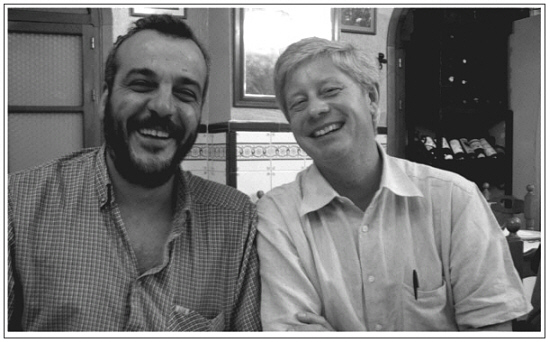
Brown bear experts Javier Naves and Jon Swenson
Jon is professor for wildlife biology, and management of natural resources at the Department of Biology and Nature Conservation, Agricultural University of Norway in Ås. He is the scientific leader of the Scandinavian Brown Bear Research Project, a long-term cooperative project between Sweden and Norway on the ecology of the brown bear in Scandinavia. I met Jon first during the 1997 conference on Brown bear research and management in Graz, and some years later he was reviewer of a manuscript on the expansion of brown bears into the eastern Alps which formed part of my habilitation thesis. For sure, his review was the longest, the most critical, but also the most constructive and helpful review I ever received. However, the paper was rejected, but some years later when new data appeared I could use his input to redo the analyses and completely rewrite the manuscript (Wiegand et al. 2004a, b.
Jon came to Leipzig to discuss with me, Eloy and Steph models of large carnivores and to think about possible modeling projects for Scandinavian brown bears. He also gave an exciting talk on:
Implications of sexually selected infanticide for the hunting of large carnivores Sexually selected infanticide (SSI) can occur when a male, who is not the father of a dependent young, may gain increased mating success by killing the young. It is promoted by disruption of the male social organization by killing resident adult males, thus allowing new males into an area or perhaps allowing other resident males to realign their home ranges. It has a solid and well-documented theoretical basis and should be expected in many species of large carnivores. SSI has been well documented in one population of lions, strongly indicated in brown bears in Sweden, and suggested for mountain lions, leopards, tigers, American black bears, and wolverines. Estimates of the effects of SSI following killing adult males on population growth (3.4-5.7% reductions in ?) are large enough to have consequences for management. In species exhibiting SSI, hunting adult males can promote it. According to the precautionary principle, wildlife managers should consider SSI when managing the hunting of large carnivores. Because there may be geographical or population differences in the occurrence of SSI, however, much more research is required before we can reliably apply knowledge of SSI to carnivore hunting management. The effects of hunting on the behavior of the hunted animals should receive increased attention from behavioral ecologists and wildlife biologists.
|
| Modified: 05.07.2007 | Resp.: Thorsten Wiegand | webmaster |