











|
|
|
|
|
|
|
|
|
||||||
|
|
||||||
|
>>Department of Ecological Modelling >> Personal homepage Thorsten Wiegand >> |
|
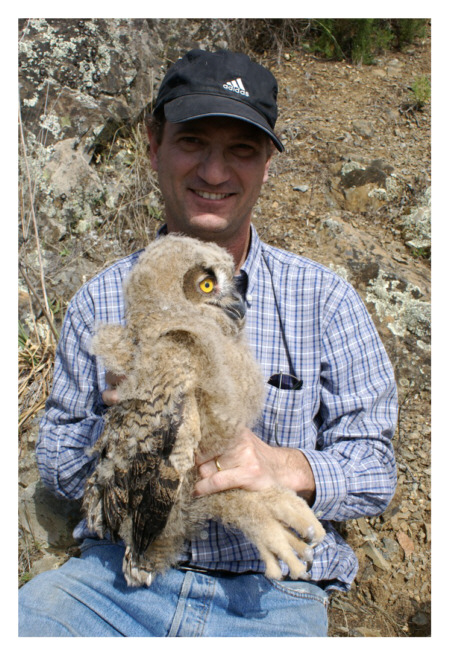
A recent photo of Cani
Jose is community ecologist and evolutionary biologist with experience in a wide range of topics, but focusing primarily on the patterns and consequences of species interactions. Over the last fifthteen years, he has focused on the ecological, applied, and microevolutionary consequences of interactions between plants and their mutualistic and antagonistic animal partners. This research has included a variety of plant and animal organisms, habitats, and geographical regions. Overall, his empirical research conducted to date has revealed the complexity and conditionality of species interactions, e.g. how their outcomes vary in magnitude and even nature (i.e., mutualism vs. antagonism) in space and time due to a myriad of biotic and abiotic factors.
Old-Field recolonization: Incorporating Allee Effects and Disperser Behaviour into Complex Recruitment Kernels
During his stay in Leipzig, he will simulate the colonization process of old fields by animal-dispersed plants in humanized landscapes. To simulate the complex process old-field colonization by endozoochores requires the combination of plant demography with rule-based and spatially-explicit modelling and animal movement. Specifically, his objectives are to: 1) develop spatially-explicit, individual-based models that simulate the distribution and dynamics of both endozochores at the old field, as determined by the movement of their dispersers and seed retention times, the resulting seed rain, and the transition probabilities for key plant ontogenic stages, 2) To optimise the models by systematically comparing simulation results versus the observed patterns of adult plants and seed rains and, thus, to indirectly identify potential missing processes or parameters in the models, and (3) Using extensive simulation experiments, to investigate the spatial and demographic consequences of contrasting realistic scenarios and to propose a general model for the colonization of old fields by animal-dispersed plants that accounts for potential Allee effects and the movements of dispersers.
|
| Modified: 08.07.2012 | Resp.: Thorsten Wiegand | webmaster |