











|
|
|
|
|
|
|
|
|
||||||
|
|
||||||
|
>>Department of Ecological Modelling >> Personal homepage Thorsten Wiegand >> |
|
Modeling factors affecting land use change in the rural-urban interface: a spatial analysis of urban growth of mid-cities in Chile (Chillan and Los Angeles)
Summary Urban growth in urban areas creates societal and ecological problems worldwide. Examples are the cities of Chillan and Los Angeles in Central Chile that have experienced important territorial transformations during the last decades, accompanied by significant transformations in their socio-spatial structure. Because of the complexity of processes and factors involved, it is difficult to understand these transformations. A detailed digital GIS database will be developed that covers land-use change over the last 40 years. The digital data base will be used to analyze the effect of urbanization on landscapes, and to model urban growth and land use change under alternative growth scenarios. GIS and spatial modeling will allow us to analyze the dynamics of land-use changes in the rural-urban interface to identify factors that promote these changes, and to interpret the spatial and temporary dynamics of these changes. Based on the results from the statistical models, a cellular automata model will be used to simulate land-use changes under alternative growth scenarios. Results can be used by the public, land use planners, and policy makers to anticipate and plan the future.
Objectives In this study we aim to identify and evaluate socioeconomic and physical factors promoting land-use changes in Chillan and Los Angeles' rural-urban interface. We assume spatially heterogeneous variables (e.g., proximity to employment or others activities; spatial distribution of the transport network and public services (sewer and water); natural features (e.g., rivers, mountains, slopes); and surrounding land uses of areas and zoning policies) that quantify these factors. The specific objectives are: n this study we aim to identify and evaluate socioeconomic and physical factors promoting land-use changes in Chillan and Los Angeles' rural-urban interface. We assume spatially heterogeneous variables (e.g., proximity to employment or others activities; spatial distribution of the transport network and public services (sewer and water); natural features (e.g., rivers, mountains, slopes); and surrounding land uses of areas and zoning policies) that quantify these factors. The specific objectives are:
Brief description The cities of Chillan and Los Angeles in Central Chile have experienced important territorial transformations during the last decades, accompanied by significant transformations in their socio-spatial structure. We will combine GIS analyses with statistical spatial modeling and simulation modeling to identify and evaluate the factors driving temporal and spatial land-use changes in Chillan and Los Angeles' rural-urban interface. This will allow us to identify the physical and socioeconomic factors that promoted these changes, and to find agricultural zones and natural spaces under pressure, and transition areas. Simulating spatial and temporal patterns of land use change under different local and regional scenarios will help to evaluate, with greater precision, the environmental and social impact of the fragmentation of the rural and urban landscape. Results from modeling urban growth and land use change can be used by the public, land use planners, and policy makers to anticipate and plan the future. The digital data base of the project can be used to analyze the effect of urbanization on landscape, and to model urban growth and land use change under alternative growth scenarios.
Methods The data comprise a wide range of factors hypothesized to impact the land-use changes. Based on available digital cartography and the analysis of aerial photographs, GIS land-use maps will be derived in steps of some 6 years, distributed between years of 1950 and 2000. Additional variables comprise natural features (e.g., rivers, mountains, slopes), surrounding land uses of areas and zoning policies, and derivate variables that describe proximity to e.g., employment, the transport network, and public services (sewer and water). The data will be transformed to raster format and compared year by year by means of superimposition techniques, map algebra and Markov matrices to detect and quantify the changes of land use through the time. Next, a conceptual model of the spatial and temporary dynamics of land use change will be developed and tested with a statistical model (e.g., logistic regression). The results of the previous steps are used to formulate transition rules for the cellular automata simulation model. Once the simulation model is calibrated, validated and its sensitivity is assessed, simulation experiments will be preformed under different possible scenarios and hypotheses.
Publications Aguayo, M., T. Wiegand, G. Azócar, K. Wiegand, and C. Vega. in press. Revealing driving forces of mid-cities urban growth patterns using spatial modeling: a case study of Los Angeles (Chile). Ecology and Society 12 (1): 13. [online] URL: http://www.ecologyandsociety.org/vol12/iss1/art13/ Abstract PDF (660K)
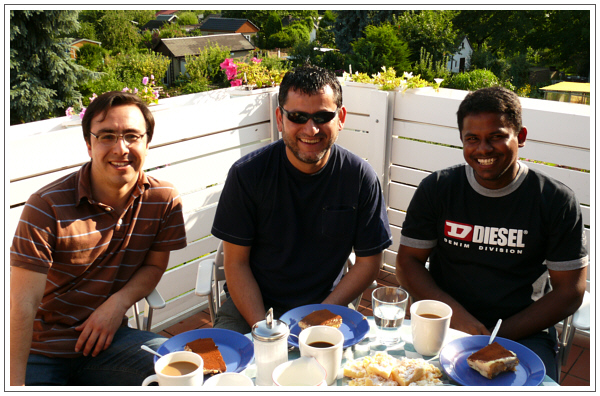
Mauricio, Gerardo and Raja enjoing Kuchen
|
| Modified: 05.07.2007 | Resp.: Thorsten Wiegand | webmaster |